




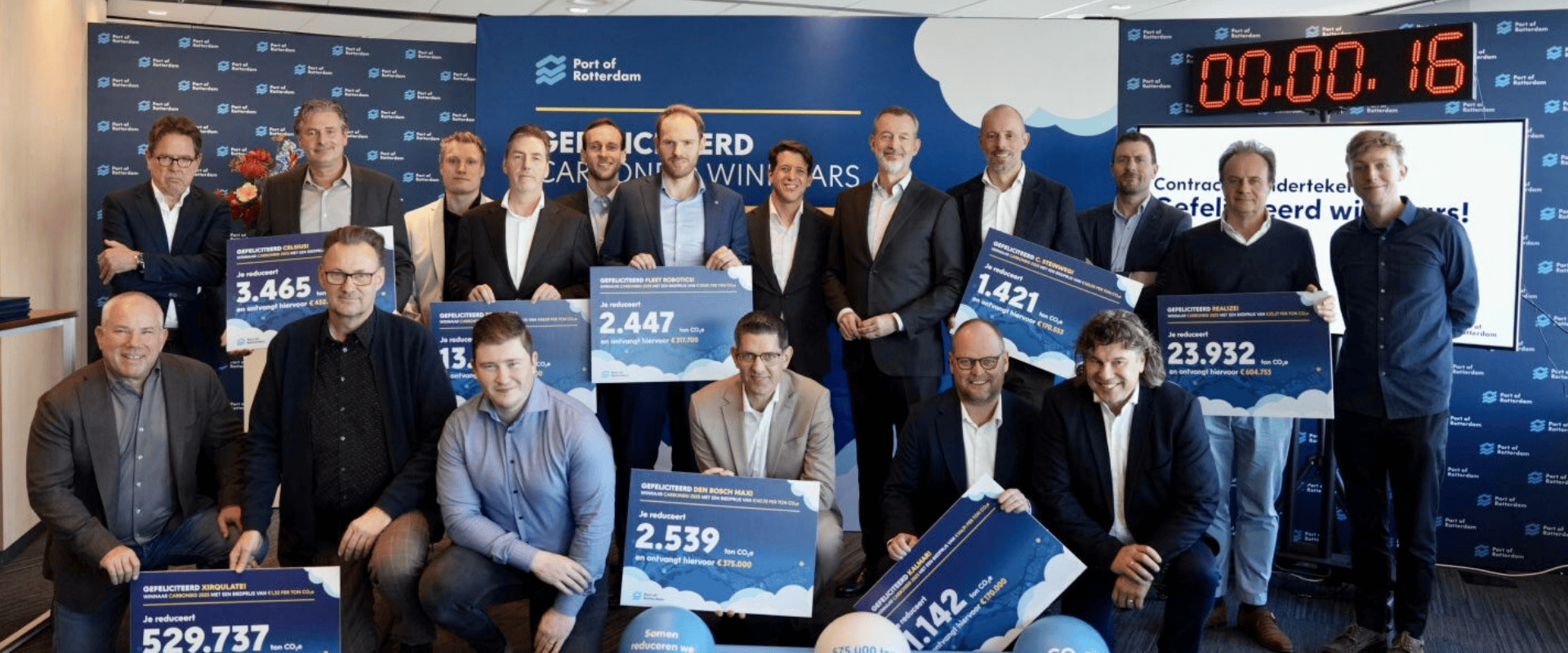
Eight projects operating in and around the Port of Rotterdam have been selected to receive funding through the Carbonbid programme, a competitive initiative aimed at accelerating cost-effective reductions in greenhouse gas emissions. Collectively, the projects are expected to reduce emissions by approximately 575,000 tonnes of CO₂ equivalent.
The Port of Rotterdam Authority will distribute €3.5 million to the selected initiatives over the next four years. Based on projected results, this equates to an average public contribution of around €6 per tonne of CO₂e reduced, underlining the programme’s emphasis on delivering the greatest possible climate impact per euro invested.
Carbonbid was established as a tender-based mechanism that rewards project developers whose proposals achieve measurable emissions reductions at the lowest cost. Unlike many climate programmes that focus primarily on industrial production processes, this scheme also targets emissions generated by logistics operators and port-related service providers.
“A great deal of attention is always paid to CO₂ reduction by industry, but logistics companies and all kinds of service providers also have emissions. We aim to use Carbonbid to persuade those parties to become more sustainable where necessary. Doing this through a tendering process will reduce the most CO₂ at the lowest cost. I am pleasantly surprised by how diverse the projects are and that we will be keeping so much greenhouse gas out of the air with this budget. Carbonbid is an innovative way to help achieve climate goals with relatively little money.”
– Boudewijn Siemons, CEO of Port of Rotterdam Authority.
Participation in Carbonbid is subject to a number of eligibility conditions. Only projects that achieve emissions reductions within the port area itself are considered, while activities covered by the European Union Emissions Trading System (ETS) are excluded. In addition, funding per project is capped to ensure that support can be spread across a wide range of initiatives.
The companies awarded contracts under this first Carbonbid round represent a broad mix of technological and operational solutions. They include Xirqulate, which converts contaminated harbour sludge from the Slufter into reusable raw materials, and Real1ze, which provides mobile ship degassing services to avoid vessels having to sail offshore to vent residual cargo vapours. Terminal operator ECT and logistics company Steinweg will both replace diesel-powered equipment with electric alternatives, while Celsius will deploy mobile shore power systems. Other selected projects include Fleet Robotics’ hull-cleaning services for small seagoing and inland vessels, the conversion of two inland waterway vessels to battery-electric propulsion by Den Bosch / Nijmegen Max, and Kalmar’s development of innovative electric reach stackers.
The selection process unfolded in multiple stages. An initial screening of 54 submitted proposals assessed whether applications met the programme’s basic criteria. Eligible applicants were then interviewed by a multidisciplinary panel of experts to evaluate technical and operational feasibility. Independent verification followed, with consultancy firm EY reviewing whether the anticipated CO₂e reductions could be accurately measured and verified. This process narrowed the field to 20 projects, from which the eight proposals requiring the lowest financial contribution per tonne of CO₂e avoided were ultimately selected.
With contracts now finalised and the full €3.5 million budget allocated, the Port of Rotterdam Authority has indicated that, given the positive outcome of this first round, a further Carbonbid tender may be organised in the future.
Interested in meeting the companies shaping more efficient and sustainable ports and terminals? Contact us today to find out more about our MTB Ports & Terminals event.